


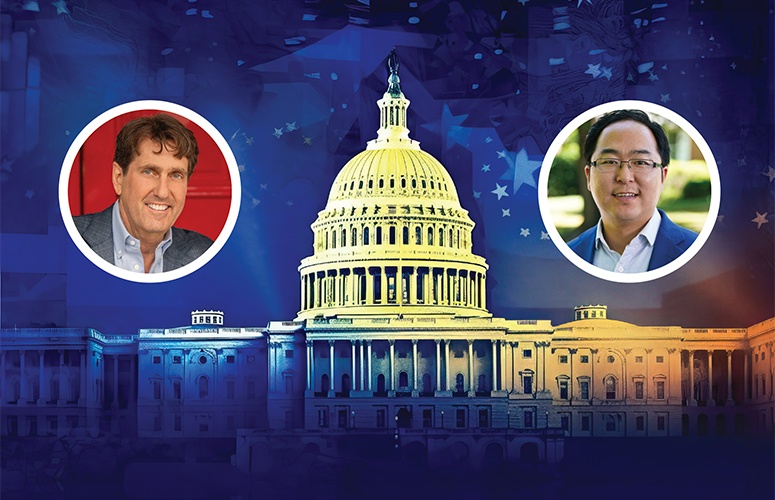
The Senatorial Battle: Bashaw vs. Kim
By Anthony Birritteri, Editor-in-Chief On Oct 9, 2024On November 5, New Jersey citizens will go to the polls to elect a US Senator from New Jersey. As is tradition, New Jersey Business Magazine has interviewed the Democratic and Republican candidates on key topics of concern to business owners and executives.
Needless to say, this Senatorial election cycle has been like no other. Many candidates threw their hats into the ring after Senator Bob Menendez was indicted on federal bribery charges on Sept 22. Most believe this election is a referendum on eliminating corruption and bringing trust back to government. Additionally, with high inflation and interest rates experienced over these past few years, this election is also about reducing the cost of living and returning residents and businesses to economic normalcy.
On the following pages, Democratic Senate Candidate Andy Kim and Republican Candidate Curtis Bashaw make their cases for normalcy and stability as they answer questions ranging from immigration, women’s reproductive rights and climate change to job creation, workforce development and how to rein in the cost of living.
Both candidates have the best interests of New Jersey residents in mind. Congressman Kim says 84% of state citizens believe New Jersey politicians are corrupt, and that he has entered the race to show people that “there is a better way.”
Bashaw, an entrepreneur and real estate developer, says running for Senate is the most important thing he has ever done. He says the United States is the “greatest exception to tyranny in the history of humankind, but our freedoms – of speech, worship, assembly, enterprise, etc. – come with a price.” Everyone has a right to these freedoms, even if you don’t agree with the views of others.
You may or may not agree with the views of the two candidates. However, it is our job to present them so that you will make an informed decision when casting your vote next month.
Curtis Bashaw
“It’s incumbent upon us to serve, or we will get the worst of us.” These are Curtis Bashaw’s words when explaining why he is running as the New Jersey Republican candidate for US Senate. The longtime entrepreneur and real estate developer announced his candidacy a few months after Democratic US Senator Robert Menendez was indicted on federal bribery charges. This event made Bashaw enter the race.
Bashaw (63) was also galvanized to run for office because of the state’s business lockdowns during the COVID-19 pandemic. “I personally thought the lockdowns were longer than they needed to be, that there was government overreach, and that we could quickly lose our freedoms and businesses,” he tells New Jersey Business Magazine. As a founder of the Cape May County-Wide Recovery Initiative, he helped design a blueprint for businesses to safely re-open and re-start the region’s economy. Bashaw recalls, “We presented our reopening plan to the state, and they ignored us. … That also made me think, ‘I’m going to do this [run for Senate].’” On Jan. 6 of this year, he announced his candidacy.
Bashaw is conservative on fiscal issues and moderate on other issues. He is pro-choice when it comes to women’s reproductive rights, saying that if elected to the Senate, he “wouldn’t support a federal ban on abortion. It is up to a woman to decide, with her conscience and her loved ones, on what to do.”
If elected, he would also become the first openly gay US senator from New Jersey and first openly gay Republican senator.
Bashaw grew up in Camden County and spent his summers working at the Jersey shore. He has spent his life in the real estate and hospitality industries and is the founder and managing partner of Cape Resorts, a hotel company focusing on the restoration and operation of classic American resort properties. Bashaw lead the landmark restorations of Congress Hall and the Virginia Hotel in Cape May. Today, Cape May Resorts owns eight hotels, 10 cottages, six restaurants, four retail outlets and a working farm, all on the Jersey shore and Long Island’s East End. The company employs more than 1,000 people.
Under Democratic Gov. Jim McGreevey, Bashaw served as executive director of the Casino Reinvestment Development Authority, overseeing the investment of gaming tax revenues in economic development projects statewide. He currently serves on the Board of Trustees of the New York Academy of Art and has served on the Board of Trustees for Stockton University, including a term as chair
Bashaw holds an MBA from the Wharton School at the University of Pennsylvania and a Bachelor of Arts in Literature from Wheaton College in Illinois. He lives in Cape May with his husband, Will.
Q&A with Bashaw
What have you heard about the needs of businesses while on the campaign trail, and what would you do to resolve some of these needs?
I’m a small business guy who started a business with 10 employees, so I’m attuned to what small businesses are saying. They are exhausted by the acrimony in our politics. They are also still in shock after the COVID-19 lockdowns. For many of them, their lives have changed forever.
For me, extreme taxation and regulations are the two things that we have to hit head on. New Jersey is a regulatory heavy state, and the federal government under President Biden has reversed the trend under the Trump administration where it was going through the Federal Register to try and get rid of crazy regulatory rules. Also, small businesses are tired of being accused of not paying their fair share of taxes. Quite frankly, they are on the front lines of the economy. They are the ones supporting the Main Streets and social organizations in their towns.
This is a defining election for them, because they feel battered and beaten up. Inflation has made the cost of their business hard to manage, and they know that consumers are hurting, so they can’t just raise prices. They’re feeling squeezed. They want leadership that will advocate for them.
Businesses are facing workforce shortages. How would you help deliver workforce training initiatives?
There are not enough workers for the jobs that are out there. Mentorships are important, and that is in the vein of apprenticeships. You take somebody under your wing and guide them. We do that in the private sector. [At my company], we partner with our county and build alliances with our schools. Those partnerships are important to business owners and the public sector.
There’s been a resurgence of interest in our tech schools and vo-techs, in mentorships and apprenticeships. My company conducts intense training, and we double down on it. We retrain and constantly look to help our workforce grow, be happy and prosper.
Businesses forever struggle with rising healthcare costs. What ideas do you have to control rising prices?
Competition, competition, and competition. Each state is responsible for its own insurance regulations, and that’s made it very hard to compete across state lines. There should be some effort to increase the competitiveness. I have been providing health insurance to every employee since 1989, but costs have gone up. It’s hard for small businesses to manage those costs when they are facing double digit increases. So, regulatory reform allowing competition across state lines, so that more people are bidding on insurance, would be one way to start.
There are other affordability options in the healthcare sphere. We need to take out the middlemen who are making money in ways that aren’t really helping the consumer or the research departments of the drug companies. The Affordable Care Act has been with us for many years … it has gotten better with time, and many people get their healthcare through [their employers]. So, I don’t think we need to upend the applecart of what we have at the current time. However, we need to make things more competitive, and we need to look for efficiencies.
As we continue to battle climate change, what are your thoughts on delivering clean and affordable energy?
Though I am not convinced that the windmills are that solution, I’m a big believer in what technology can do. We have become a lot cleaner over time [concerning energy production]. We have learned more about the impact of fossil fuels on our global environment. Those of us who love New Jersey and are lifelong residents understand how beautiful the state is. The Jersey shore is a huge resource we need to protect.
I do think some energy issues have been politicized, but overall, we need to: A, return to energy independence; and B, have an all-of-the-above approach, allowing technology and research to move us into the next generation of energy.
What is your stance on immigration policy and dealing with the ongoing border crisis in Mexico?
We have conflated border security and immigration policy, which is unhealthy. We need to decouple them. I went to the border a few weeks ago and stood at an unfinished section of the wall from midnight to 3 a.m. I watched 62 people walk into our country. It was if they had TSA PreCheck. They were from China, Syria, Ecuador, Venezuela, all over the world. Many of them didn’t seem as destitute as you might think. Some had plane tickets to Phoenix, others had assylum dates for 2027. Standing there watching this happen, it became clear to me that border security, decoupled from immigration, is just not a partisan issue. It shouldn’t be. A country has borders by definition. How can you have an immigration policy if there’s a secret passage that you can go through? It’s not a racist thing. It’s just what a country does so that it can then have an immigration policy.
I’m pro-immigration. A third of [my company’s] workforce are first-generation Americans who came here legally through a 3- to 4-year process. We are a land of immigrants and New Jersey is a diverse state, but we are being impacted by this open border in a disproportionate way. We’re a sanctuary state with sanctuary towns. We don’t even know where these people are from. Quite frankly, my opponent is soft on this. He voted against stuff that would secure the border. I don’t understand it, and neither do most voters.
We also need workers in certain service sectors. I don’t want to take American jobs away from anybody, but I don’t mind having new Americans that come through a legal process to join us in pursuit of the American dream. We need them. I want us to roll up our sleeves and create a policy that helps small businesses.
Where do you stand on global issues such as Ukraine, Israel and Gaza, and China, for example?
The Biden administration’s leadership is weak and has sent bad signals globally, starting with that botched withdrawal from Afghanistan. Then we had Russia invade Ukraine, Hamas attack Israel … even related chaos on our college campuses.
I believe in peace through strength, and we need strong leaders to demonstrate strength on the world stage. I am not an isolationist. I believe that Putin needs to be stopped. Of course, I believe there should be accountability to the dollars that we spend so we’re not just writing blank checks. But I would much rather be sending [money] over [to Ukraine] than have Putin accidentally hit a NATO country.
The Israel situation was a terrorist attack. They [Hamas] took hostages. I support our democratic ally in the Middle East. Israel has a right to defend itself until the hostages are released.
Regarding China, if we as a nation are weak on the world stage, if we’re second guessing ourselves, if we’re appeasing, that doesn’t help us with China. The Biden administration stopped sanctions in Iran and terrorism has increased. I would not isolate us from the rest of the world, but I would have peace through strength and try to settle down these conflicts by hopefully having a strong leader.
Earlier this summer, we noted the two-year anniversary of the abolishment of Roe v. Wade. With that, what are your views on women’s reproductive rights?
I’m a freedom person. I’m pro-choice. I believe the constitution provides for our domestic tranquility. In my home, I can live my life and pursue my happiness as I see fit. We don’t want to be told what to do, and we shouldn’t be telling others what to do.
This issue of abortion is pretty settled in New Jersey. The Legislature proactively passed protections anticipating a possible court decision. In the Senate, I wouldn’t support a federal ban on abortion. I believe it is up to a woman to decide, with her conscience and her loved ones, on what to do. If there’s a bipartisan effort in Congress to enshrine those protections, I would certainly read and study and look at that as an option to make sure that those rights can’t be taken away.
Besides actions by the Federal Reserve, what would you do in the Senate to stem both high interest rates and inflation?
I don’t believe we can spend our way to prosperity. The deficit has grown a lot in recent years, both at the state and federal government levels, and that devalues the dollar. If there are more dollars, they are going to be worthless, and inflation is a crushing thing to families and small businesses. We need to have more fiscal discipline and responsibility regarding spending. Again, we need to unshackle businesses from too many regulations and too much taxation so we can grow the economy and tamp down on inflation. I’m definitely a free market person who believes in the power of private enterprise to help businesses grow and prosper.
How do you view artificial intelligence, from it being an innovative, economic driver to it raising security concerns?
We get seismic shifts in technology. Throughout history, [inventions come about] that make life easier, [but] also create different kinds of risks. [With AI] there’s the potential for fraud and cyber-attacks. The Senate Commerce Committee recently took up a number of bipartisan measures on key AI related issues that are important for us to look at. We’re learning as we go. It’s fun to get help researching a subject by using AI, but I’m mindful of how scary it is to put so much of our information in the hands of others.
We need to have the right set of regulations that allow us to receive the benefits of this new technology and make our lives richer, while making sure that we think about the unintended consequences as it relates to criminal activity.
New Jersey has consistently been a donor state, giving more tax dollars to Washington, D.C. than we get in return. What are your thoughts on getting more state aid back?
We’ve had five decades of a Democratic monopoly in the Senate. We are trying to restore some Republican perspective to it. That said, we’ve had a very divided government for too many years. I want to work across the aisle with Republicans and Democrats, to get things done for New Jersey. We give a lot of money to Washington D.C. We are the third or fourth highest donor state. And while we contribute, we get back maybe 75 cents on the dollar. We can do better. Senator Booker and I can tag team and work together to do better for the state. I’m excited about that, and I think voters are ready for people that will just get stuff done. Let’s get back to the commonsense stuff.
Why are you running for US Senate?
It is incumbent upon us to serve, or we will get the worst of us. I was galvanized during the COVID lockdown. I thought the lockdown was longer than it needed to be. There was [government] overreach. I worked hard in my county [Cape May] to form a taskforce the day after the lockdown to mobilize our county commissioners, our 16 mayors, our business leaders. We worked hard to write a thorough reopening plan. We sent it to the state, and they ignored us. … That made think of getting involved [in politics]. When Senator Menendez got indicted a second time, and the governor’s wife thinking she should just have the seat, … it made me say, ‘I’m going to do this.’”
Andy Kim
A three-term Democratic Congressman who announced he would seek Senator Robert Menedez’s US Senate seat a day after Menendez was indicted on federal bribery charges, Andy Kim says he entered the race because he’s tired of “constantly watching our politics fail our nation.”
“The next four to five years are going to shape the next four to five decades of this country,” Kim tells New Jersey Business Magazine. “Meanwhile, the vast majority of people are frustrated and don’t trust either party. One day I asked my neighbor how he felt about Senator Menendez’s indictment. He said, ‘That’s just Jersey politics.’
“I don’t want the state to have that reputation,” Kim says. “I don’t want us to be a laughingstock.”
A public servant his entire career, Kim says he has worked with both Democrats and Republicans. He hopes that New Jersey voters see him as someone who is “earnestly trying to serve, who is in awe of this country.”
It was Kim’s parents who perhaps engrained this sense of awe for the US in their son, as they immigrated here from Korea 50 years ago to seek a better life for themselves and their family.
Growing up in Marlton and Cherry Hill in South Jersey, Kim attended Deep Springs College in California before transferring to the University of Chicago where he graduated with a degree in political science in 2004
Kim received a Rhodes Scholarship and a Harry S. Truman Scholarship to study international relations at Magdalen College, Oxford. There, he became friends with fellow Rhodes Scholar Pete Buttigieg, now the US Secretary of Transportation. He has worked for the United States Agency for International Development (USAID), the Pentagon, the State Department, the White House National Security Council, and served in Afghanistan as an advisor to General David Petraeus and John R. Allen.
He was first elected to Congress in 2018 and is the first Asian American elected to federal office from New Jersey. In 2018 and 2020, Kim defeated two self-funding millionaires in a district that was carried by former President Trump. In 2022, he defeated another self-funding millionaire.
His committee memberships in Congress include the House Armed Services Committee (including serving on two subcommittees) and the House Foreign Affairs Committee (including two subcommittees).
He says he is running for US Senate to “restore a sense of integrity and represent the people of New Jersey with compassion and the trust we all deserve.
“I don’t have a magic wand,” he says, “but I’m going to do my best.”
Q&A with Kim
What have you heard about the needs of businesses while on the campaign trail, and what would you do to resolve some of those needs?
Businesses are feeling a lot of anxiety about what comes next. They don’t have a sense of whether or not they should invest in their businesses. That unpredictability is driven by the instability within our politics and within our governance; about what comes next with interest rates and what comes next with regards to the markets. Access to capital is also a concern. This all creates difficulty for businesses that were coming out from the pandemic and feeling positive momentum.
Concerning access to capital, that’s something that I’ve worked on [in conjunction] with the US Small Business Administration (SBA) and the federal government in trying to have more resources available to small businesses. There was a tremendous amount of small businesses engaged with the government during the pandemic with various assistance programs. There’s an opportunity for us to be able to build upon that; to show that government can play a supporting role [by providing] other things that businesses could draw upon when it comes to accessing capital.
We’ve also displayed this supportive role with the Inflation Reduction Act (IRA), where government is engaging and thinking through how it can work with the private sector to solve problems like climate change. In talking with the business community, especially the energy companies, there is excitement over the IRA model. We can use this model for other industries and continue to supercharge innovation. Government needs to further lean in and figure out how to help.
Businesses are facing workforce shortages. How would you help deliver workforce training initiatives?
Everyone is saying they need workers to be able to grow their businesses. This is why we need to make sure we’re investing in education; K-12 and beyond. Unfortunately, there is a battle right now in Congress about the level of investment in our public schools. This is about the collective good. Our country and economy are stronger when we have a more educated and skilled workforce.
We also need to make sure there are different opportunities for Americans after high school. Not everyone needs to go to a four-year college. So, I’ve been trying to push opportunities for apprenticeships at trade schools.
Additionally, we still are a magnet for global talent. These people want to innovate and start businesses here. We should be taking steps to increase opportunities [for foreigners] to take advantage of H-1B visas and other types of visas in the effort to draw in the high-skilled labor. Additionally, we shouldn’t be pushing [foreign students] away. These are people who are educated here, trained here, and then they return to their countries and start companies that compete with ours? We’re missing the ball on that and must avoid the hyper partisanship that surrounds immigration.
What is your stance on immigration policy and dealing with the ongoing border crisis
in Mexico?
I believe in having control over all our borders and making sure we’re keeping our country safe. I’m also a son of immigrants, who is married to an immigrant. I get frustrated that much of the political debate is [painting] all immigration with the same brush as what is being talked about concerning the southern border. There is no doubt there are problems at the border. I want an orderly system where we control the flow of immigrants coming in. We are a country with laws and we should abide by those rules.
Right now, we have more than 3 million pending immigration cases in the nation, but we only have about 682 federal immigration judges. It would take those judges 10 years to get through the backlog. We’re taking about six years plus, per immigration case, whereas we’re supposed to do it in six months or less. I’m working on bipartisan legislation that would drop that [time frame] down to 30 to 60 days.
Businesses forever struggle with rising healthcare costs. What ideas do you have to control rising prices?
I recently participated in a town hall session where a third of the questions were about healthcare. Businesses are struggling trying to figure out how to pay for employee healthcare benefits. I’ve put forward bipartisan legislation to make sure there are different ways to address some of the costs. My particular focus has been on out-of-pocket expenses. I’ve heard from people who are paying $400 to $500 a month on prescription drug costs, for instance. I introduced legislation that would cap out-of-pocket costs for seniors at $2,000 a year, which is $166 a month. We’re trying to figure out how to spread this to all Americans.
As we battle climate change, what are your thoughts on delivering clean and affordable energy?
We can provide clean energy options and supercharge it in a way that is responsible and good for businesses. We want the US to be the leader of the innovative energy economy. We don’t want other nations leapfrogging us with the technology that was created here. The Inflation Reduction Act has been a success so far by turbocharging the business community. We’re seeing a tremendous amount of innovation happening, and that can help us reduce costs for Americans in terms of [bringing] energy efficiency into their homes.
You’re talking about innovation. Do you feel these solutions will be implemented fast enough to battle what’s happening in terms of global heatwaves?
We’re behind the curve when trying to prevent 1.5 to 2 degrees Centigrade increases in global temperatures. What we’re trying to do is mitigate some of the worst of the effects of climate change. The US cannot do this alone. We need to mobilize other nations and get them on board.
Where do you stand on global issues such as Ukraine, Israel and Gaza, and China, for example?
I have worked at the State Department and the Pentagon. I’ve worked at a military base in a war zone. I spent my career doing national security. Having worked in those capacities I have never seen a more precarious moment globally than right now. As a father of a seven-year-old and an eight-year-old, I’m terrified about what comes next. I don’t think war is inevitable or that the US will get sucked into a conflict, but we cannot know for certain.
We should take steps to continue strengthening our military. I’m on the Armed Services Committee, and I want to see [military] investments.
That said, America’s competitive advantage, when it comes to national security, has always been the ability to leverage allied partnerships. We see the strengthening of NATO right now in a way that we’ve not seen since the end of the Cold War. We’re also trying to build up Indo-Pacific partnerships that will help us add stability to the international system.
Earlier this summer, we noted the two-year anniversary of the abolishment of Roe v. Wade. With that, what are your views on women’s reproductive rights?
This is a very scary moment. … We see this sense of moving backwards as a country. This comes down to a sense of freedom for people to make decisions about their own body, about being able to make decisions about their own family. This is the biggest difference between me and Mr. Bashaw. He has been very adamant and public about supporting the Supreme Court’s Dobbs decision that overturned Roe v. Wade. He thinks it’s fine for politicians at the state level to restrict abortion even in extreme cases of rape and incest.
Mr. Bashaw says he is pro-choice.
One cannot be pro-choice and then say that the government is able to take away your choice to make decisions about your body. He’s trying to do this as a political maneuver because he sees the backlash on Republicans all across the country when it comes to abortion. So, he’s taken on that [pro-choice] moniker, but it’s deceptive.
[The conversation is] not just about abortion. We see the attack on IVF. We see the attack on contraceptives. I am in Congress trying to pass legislation to codify IVF contraceptives. We shouldn’t have to deal with things like this in 2024.
How do you view artificial intelligence, from it being an innovative, economic driver to it raising security concerns?
It’s been remarkable to see what AI can do, but I am concerned about some of the nefarious actions that could occur.
I can see this doing so much good in helping people navigate their lives. I also can see this benefiting healthcare. AI can help doctors look at X rays, CAT scans or MRIs, and identify health issues. However, we also are worried about the possibility of disinformation – weaponizing this technology for things like deep fakes that are going to make it harder for us to know what’s real and what’s not.
I’ve talked with OpenAI CEO Sam Altman and other leaders a number of times about this. The genuineness with which they are coming to Congress and saying we need some type of regulation and protection to avoid some of the worst uses … we need to take that seriously. We need to move faster.
Besides actions by the Federal Reserve, what would you do in the Senate to stem both high interest rates and inflation?
The COVID-19 pandemic was a global crisis that overloaded our supply chain and our ability to procure raw materials and products. We saw the catastrophe that occurred afterwards in terms of high costs. In particular, we saw huge problems when it came to semiconductor manufacturing abroad. That’s a big reason why I supported and helped pass the CHIPS and Science Act, [which is making] major investments in the development of advanced manufacturing capabilities here. It’s not just good for our innovation and our economy, it’s about making our country more resilient and less dependent on other nations.
New Jersey has consistently been a donor state, giving more tax dollars to Washington, D.C. than we get in return. What are your thoughts on getting more state aid back?
Let’s talk about one of the biggest issues here when we look at the ballot this November: The person who created the SALT cap that prevents New Jersey families from deducting their full property tax is running for US president. Trump is the one who has hurt so many New Jersey families. We’re already paying too much to the federal government compared to what we’re getting back and the SALT cap is supercharging this.
Why are you running for US Senate?
I decided to take this on because we’re at an inflection-point in our country. The next four to five years are going to shape the next four to five decades. The vast majority of people right now can’t stand or trust either party. In New Jersey, 84% of the people believe politicians are corrupt.
Senator Menendez’s indictment and conviction further eroded that trust. I’m trying to show that there’s a different way to conduct politics. People may not agree with every single thing I do – that’s just the nature of a state with 9 million people and a country with 330 million people. However, I hope people see in me someone who’s earnestly trying to serve. I’m running for Senate on the 50th anniversary of my family coming to America. I feel blessed, but I don’t know what’s coming next for my children That’s why I’m doing this: To help fix things as best as I can.
To access more business news, visit NJB News Now.
Related Articles:

- Accounting
- Artificial Intelligence
- Banking / Financial
- Coronavirus
- Diversity
- Economic Development
- Economy
- Energy
- Environment
- General Business
- Government
- Healthcare
- High-Tech
- Higher Ed
- Infrastructure
- Labor
- Law
- Life Sciences
- Manufacturing
- Meeting Places
- Mergers & Acquisitions
- New Hire/Promotion
- Philanthropy
- Real Estate
- Science & Technology
- Small Business
- Tourism
- Transportation
- Workforce Development
- Special Sections
- Sponsored Content
