



Defense Manufacturers Serve with Pride & Precision
New Jersey manufacturing firms play a critical role in supplying specialized products to the United States military.
By George N. Saliba, Contributing Writer On May 7, 2025Underscoring the often-secretive nature of US defense manufacturing, Piscataway-based Montrose Molders Corporation is provided with strict specifications for manufacturing cartridge shells, but company President Brendan Wilson explains to New Jersey Business Magazine that he has “no idea” how the products are ultimately used by the military.
Upon creating the cartridge shells from high-impact polystyrene, polycarbonate Xenoy or Ultem – with Ultem having extremely high temperature resistance, high mechanical strength, chemical resistance and dimensional stability – Montrose Molders then transfers the shells to Tier I and Tier II defense suppliers that Wilson declines to name.
“Unfortunately, [some of] these resins are very expensive and difficult to process, but that’s why I am proud of our team, because we have so much experience processing [things] like Ultem or Xenoy,” Wilson says.
The firm also creates connectors, washers and fitting components found on naval vessels, as well as housings for military thermal detection devices. A molded ripcord for small, inflatable military vessels additionally is in Montrose Molders’ product lineup.
The Defense Manufacturing Sphere
Overall, an array of New Jersey manufacturers quietly furnishes defense products as part of an enormous US defense landscape: In 2023, the United States accounted for approximately 40% of global military spending at $820 billion, dwarfing China’s estimated $296 billion and Russia’s $109 billion. Underscoring the scope of America’s endeavors is the fact that our military is comprised of a staggering 2.86 million personnel and has more than 399,000 ground combat vehicles, as well as over 13,000 aircraft across various military branches, for example.
Defense Budget Cuts
While there has been much publicity regarding proposed cuts to the military that could amount to $50 billion annually over the next five years, this concept is arguably misleading because the Pentagon has prioritized 17 spheres for strategically increased funding. With more than 700,000 civilian Pentagon employees, Defense Secretary Pete Hegseth said the Pentagon must “cut the fat (HQ) and grow the muscle (warfighters),” pointing toward an ethos of optimizing efficiency rather than reducing the military’s prowess.
This is arguably good news for New Jersey defense manufacturers, although Montrose Molders’ Wilson more broadly notes that he has not seen a fluctuation in demand nor changes to product requirements in recent years. He adds, “There’s more conflict in the world than there has been in past years, and while we certainly don’t hope for that, we stand ready to do our part should the Department of Defense or its suppliers require us to produce more for them.”
ZAGO Manufacturing
Not all New Jersey defense manufacturers are as sanguine: Gail Friedberg Rottenstrich, co-founder and CEO of Newark-based ZAGO Manufacturing, expresses concerns about defense manufacturing, saying (at press-time), “It’s just hard to know where things are going, right now. There’s been so much change in the last several weeks; things getting cut and then reinstated [by the government]. It’s hard to understand the metrics that are being looked at to determine what stays and what goes with respect to defense.”
ZAGO manufactures sealing screws, and its equipment applications range from ground and air night vision goggle/thermal cameras to security and radar detection systems as well as military grade robots/drones, for example. One ZAGO product category is comprised of fasteners such as screws, nuts, bolts and washers, while another category consists of sealing switch boots for electronics.
Friedberg Rottenstrich stresses, “The most important aspect of the product is its ability to withstand pressure. When we are talking about aerospace or submarine conditions – where there are rapid changes in pressure – our parts really stand up.”
Marotta Controls
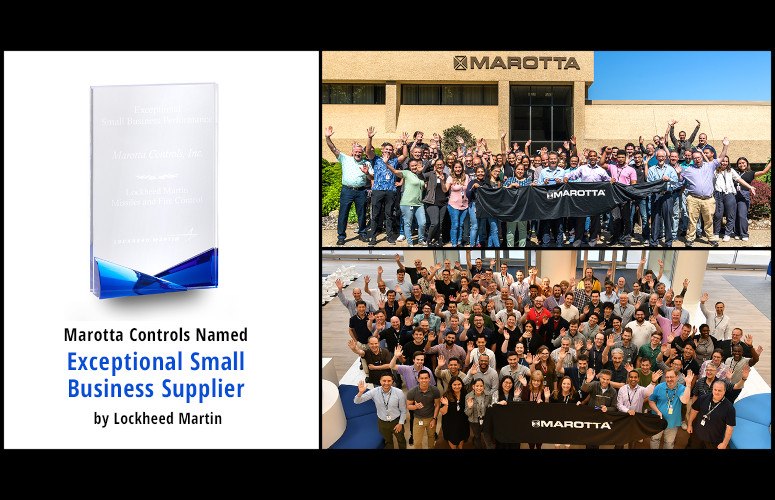
Likewise designed for extreme environments (including factors such as temperature, vibration, shock and humidity levels) are Montville-based Marotta Controls’ shipboard controls, critical controls for tactical systems, and controls for aerospace systems. The company’s equipment is nearly ubiquitous in the military, with Marotta’s Senior Vice President of Power and Actuation Systems Steven Fox telling New Jersey Business Magazine that Marotta’s systems are “on every surface ship and submarine in the U.S. Navy.” The products are also found on numerous missiles, drones and torpedoes, and are additionally onboard aircraft such as the F-35 Lightning II and F/A-18E/F Hornet fighter jets as well as the SH-60 Seahawk helicopter, for example.
Sales have been strong: Marotta Controls experienced increase in demand for its products via the 2022 onset of the Russia-Ukraine conflict, and it has more recently seen a spike in demand to replenish those initial supplies. Overall, the 82-year-old company has grown from approximately 300 employees five years ago to almost 900 today. Fox explains that his firm has “disrupted” longstanding markets because its products offer size, weight and cost advantages when compared to competitors’ goods. Fox predicts his firm will increasingly manufacture autonomous vehicle (i.e., “drone”) systems utilized in sea, air and land environments.
New Jersey Defense Manufacturing Community Consortium
Most New Jersey manufacturers do not have Marotta Controls’ experience. For some of the state’s 9,000 manufacturing firms interested in undertaking defense manufacturing for the first time, working with the Department of Defense (DoD) can be overwhelming.
However, assistance is available. Funded by the DoD’s Local Defense Community Cooperation, the New Jersey Defense Manufacturing Community Consortium (NJDMCC) has key goals of both training manufacturers to be part of the DoD supply chain and/or expanding current contracts. NJDMCC also facilitates manufacturers’ hiring of veterans.
With myriad rules and regulations associated with becoming a DoD supplier, it can be challenging for small- to medium-sized businesses to “take on all of that, and kind of eat the elephant all at once,” explains Michael Womack, director of marketing and communications at the New Jersey Manufacturing Extension Program (NJMEP), the entity which formed the NJDMCC.
Womack adds, “[We] provide training, resources, connections and networks that can help make the process much easier and smoother. One of our partners is actually providing curriculum on the entire financial aspect of your organization: What do you need to do to get your ducks in a row to ensure that when someone comes to you from the DoD with a contract in hand and they ask for very specific rules and regulations, your business is structured correctly [to deliver] what they need.”
Womack also says, “[We want you to say] ‘I am prepared.’ Because if [you answer] ‘no,’ it can be very hard and take a very long time to get back to that table where you have [another] shot at a DoD contract.”
To access more business news, visit NJB News Now.
Related Articles:
- Accounting
- Artificial Intelligence
- Banking / Financial
- Coronavirus
- Diversity
- Economic Development
- Economy
- Energy
- Environment
- General Business
- Government
- Healthcare
- High-Tech
- Higher Ed
- Infrastructure
- Labor
- Law
- Life Sciences
- Manufacturing
- Meeting Places
- Mergers & Acquisitions
- New Hire/Promotion
- Philanthropy
- Real Estate
- Science & Technology
- Small Business
- Tourism
- Transportation
- Workforce Development
- Special Sections
- Sponsored Content
