

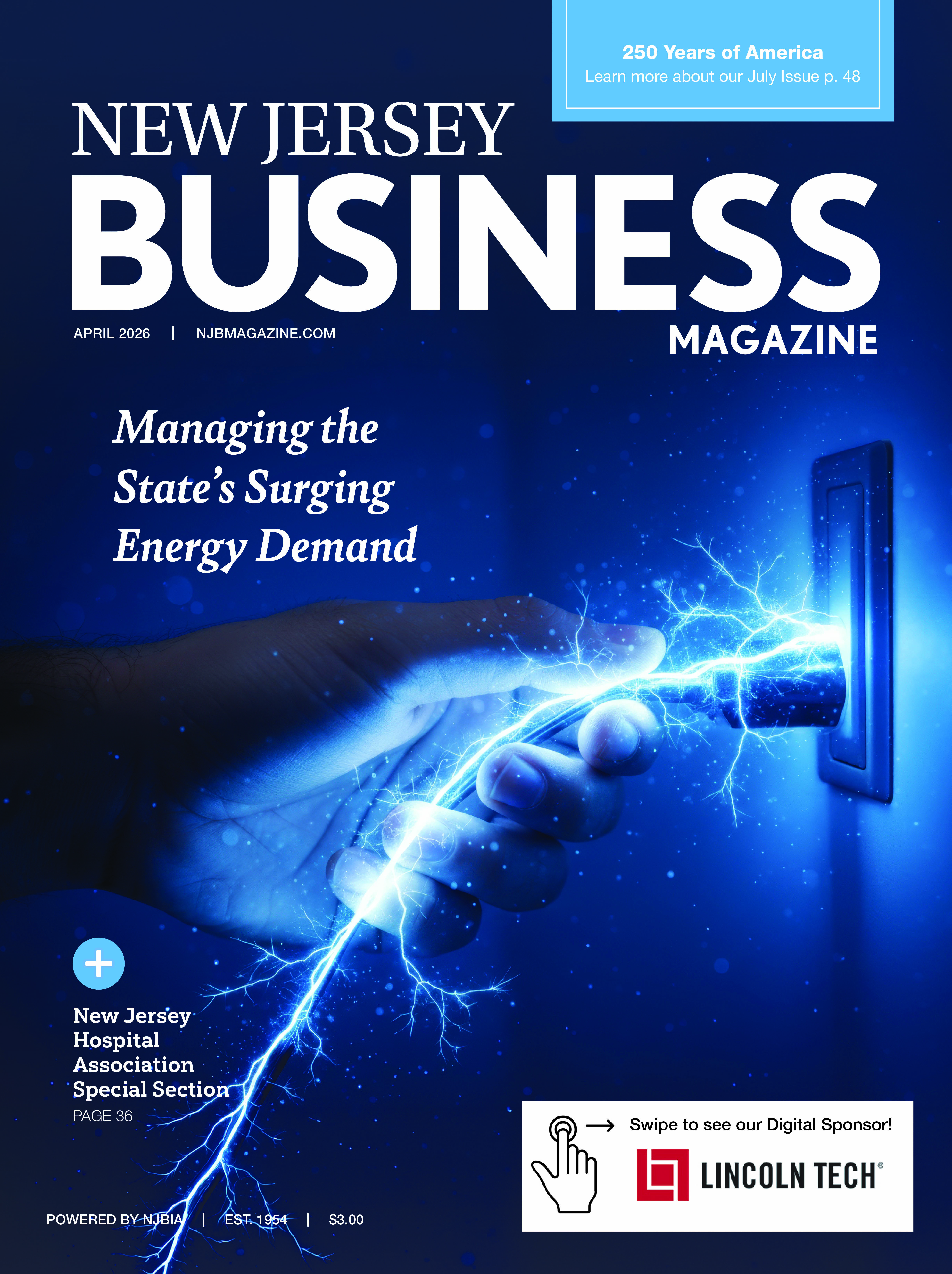

Managing the State’s Surging Energy Demand
Energy stakeholders eye a collective approach to solve the supply-and-demand puzzle in the midst of an unprecedented increase in electricity demand.
By Jim Pytell, Managing Editor On Apr 1, 2026According to the most recent power demand forecast from Washington, D.C.-based consulting firm Grid Strategies, US electricity usage is estimated to increase at an annual rate of 5.7% per year over the next five years, with peak demand increasing by 3.7% annually during that same period. Put into perspective, power consumption has increased less than 1% annually over the past 20 years.
Despite utility capital investment growing steadily over the past decade, achieving this higher growth rate would require the electricity industry to plan and build new generation and transmission capacity at more than six times the rates seen in recent years, the forecast writes.
Grid Strategies notes that it is possible these significant growth projections could be an overestimate, as utility forecasters are still adapting to surging large loads, and uncertainty remains high. However it adds that even conservative growth trajectories outpace recent years and would require substantial grid expansion to accommodate.
This tremendous increase in demand is driven by a number of factors. Leading the way is AI-driven data center expansion, accounting for about 55% of demand growth in utility load forecasts over the next five years, but broad-based electrification and increased domestic manufacturing, though smaller than data center growth, is large compared to recent decades.
The need, then, is obvious: more supply is needed to keep up with this increased demand – but that is easier said than done.
Additional Supply
“The biggest bottleneck is that the current market and policy structure is not delivering new, reliable generation fast enough to keep up with demand,” Andrew Hendry, region president for Atlantic City Electric, tells New Jersey Business Magazine. “Across New Jersey and the PJM region, we’re seeing retiring baseload power plants, delays and withdrawals of new renewable projects, and long interconnection timelines, all while electricity demand is rising rapidly due to electrification, data centers, and economic growth.”
In-state energy generation has indeed plummeted over the past decade, as New Jersey has seen closures of the Oyster Creek nuclear plant and five coal-fired power plants, along with cancellation of massive offshore wind projects once touted by former Gov. Phil Murphy as a key long-term energy solution.
Additionally, many New Jersey residents saw a 20% increase in their energy bills last year – which can, at minimum, be partially attributed to a supply and demand imbalance in the state.
“There is a new industrial revolution that’s going on right now, and that is all around data centers and AI, and they use an enormous amount of energy,” says South Jersey Industries (SJI) President & CEO Michael Renna. “If New Jersey wants to compete in this space, we have got to solve this problem.”
Renna says that unless New Jersey brings more power online to meet increased demand, the state will struggle to attract AI data centers and large-scale cloud service providers.
“We are going to fall behind from an economic development standpoint. Despite all the advantages New Jersey offers, we’re going to end up falling behind, because those developers are going to go where the energy is,” he says.
PSEG CEO Ralph LaRossa, who points out that there hasn’t been a new power plant built in New Jersey in more than a decade, says that the “lack of momentum” for traditional power generation sources, coupled with growing user demand, means New Jersey must now import energy from other states.
“We have put a lot of extension cords into Pennsylvania,” he says. “Any of the extra load we are now servicing is coming from Pennsylvania. It’s a simple supply and demand equation. And there’s not a market signal that’s telling generators to come in and build.”
The issue, of course, is that increasing energy generation cannot be done overnight, with Renna noting that it takes at least five years to bring gas-fired power generation online, for example.
“It’s probably going to be closer to seven [years] when you factor in the permitting and the supply chain challenges that exist in New Jersey,” he adds. “So, if we’re dealing with a deficit right now where we’re importing more energy – and then we are therefore subject to the prices associated with importing that energy – we are at least seven years away from any kind of meaningful generation being brought online in New Jersey.”
New Jersey has seen rapid expansion of solar deployment, in part through New Jersey Board of Public Utilities (BPU) initiatives such as the Community Solar Energy Program and Competitive Solar Incentive program.
“There is nothing else that can be deployed as quickly and be as effective in bringing down [these] high-capacity prices [as solar],” says Lyle Rawlings, president and CEO of Flemington-based Advanced Solar Products.
However, this progress is hindered by an electric distribution grid with severe hosting capacity constraints on key circuits, according to the BPU.
LaRossa suggests that the state produces an integrated resource plan that details how electric utilities will reliably meet customer demand for the future, adding that the state hasn’t had an integrated resource plan since 2000.
“The Energy Master Plan is not a complete integrated resource plan,” LaRossa says. “And no offense to any administration, we can’t look back and complain about that. What we need to do is look forward and what we’re advocating for very strongly is that we need to get together and work on that plan.”
“New Jersey is facing a generation shortfall driven by power plant retirements and delayed new energy supply, transmission constraints that slow the delivery of power where it’s needed most, and policy barriers that limit who can build generation and how quickly projects can move forward,” Hendry says. “Addressing only one of these issues won’t solve the problem. That’s why we’ve been advocating for an ‘all of the above’ approach that includes new generation, transmission investment, energy efficiency, and policy changes.”
Modernizing the Existing Grid
In addition to getting more generation online, it’s worth mentioning that modernizing existing grid infrastructure is just as important an endeavor.
“Much of the grid was built in the 1960s and 1970s … and 70% of the grid is 25 years or older,” explains Christie 55 Solutions Managing Director Bob Martin. “It’s not just about growth and adding more lines; we also have to deal with replacing aging transmission lines, substations, and other key components. The grid is unprepared for the load that we need to support. … You can generate all the electricity you want, but if you can’t plug it into the grid, or you can plug it in, but can’t deliver it where it needs to go, it doesn’t make a difference.”
Martin emphasizes that policymakers must address both energy generation and transmission in tandem. “We can’t separate the generation issue from the transmission issue, but we need to isolate the challenges and solutions for each,” he says.
Martin adds that long-term planning and stronger cooperation among federal, state, and local stakeholders – including utilities and Regional Transmission Operators such as PJM – as well as innovative public-private partnerships to accelerate investment in grid modernization, are essential.
“The electric grid needs to be modernized, it needs to be upgraded, and it needs to be expanded well beyond what it is today,” Martin says.
Hendry adds that while significant progress is being made in strengthening and modernizing the electric grid, additional investment and planning will be needed to meet New Jersey’s goals.
“What’s clear is that the level of investment required is significant and sustained – across generation, transmission, and distribution infrastructure,” he says. “Utilities are already making multi-year investments to modernize the grid, improve resiliency, and prepare for electrification. At the same time, how we invest matters just as much as how much we invest. These investments must be made in a way that is affordable, transparent, and sustainable for customers.”
Looking Ahead
When it comes to Trenton, there is a sense of optimism that Gov. Mikie Sherrill will be open to collaborating with stakeholders to help find solutions to the state’s energy demands. For what it is worth, she campaigned on transparency and government efficiency, has said she wants to engage with the business community, and also signed Day One energy-related executive orders, one of which targets expediting power generation in the state.
“Governor Sherrill has shown she understands the underlying challenges facing New Jersey’s energy system, and [we] look forward to working with her, regulators, and other stakeholders on solutions that protect affordability while ensuring safe and reliable service,”
says Hendry.
“Ultimately, if supply doesn’t keep pace with demand, higher costs and reliability risks can undermine competitiveness. Energy policy and economic growth work best when clean energy goals are paired with practical pathways to build infrastructure and maintain reliability.”
To access more business news, visit NJB News Now.
Related Articles:


- Accounting
- Artificial Intelligence
- Banking / Financial
- Coronavirus
- Diversity
- Economic Development
- Economy
- Energy
- Environment
- General Business
- Government
- Healthcare
- High-Tech
- Higher Ed
- Infrastructure
- Labor
- Law
- Life Sciences
- Manufacturing
- Meeting Places
- Mergers & Acquisitions
- New Hire/Promotion
- Philanthropy
- Real Estate
- Science & Technology
- Small Business
- Tourism
- Transportation
- Workforce Development
- Special Sections
- Sponsored Content
