

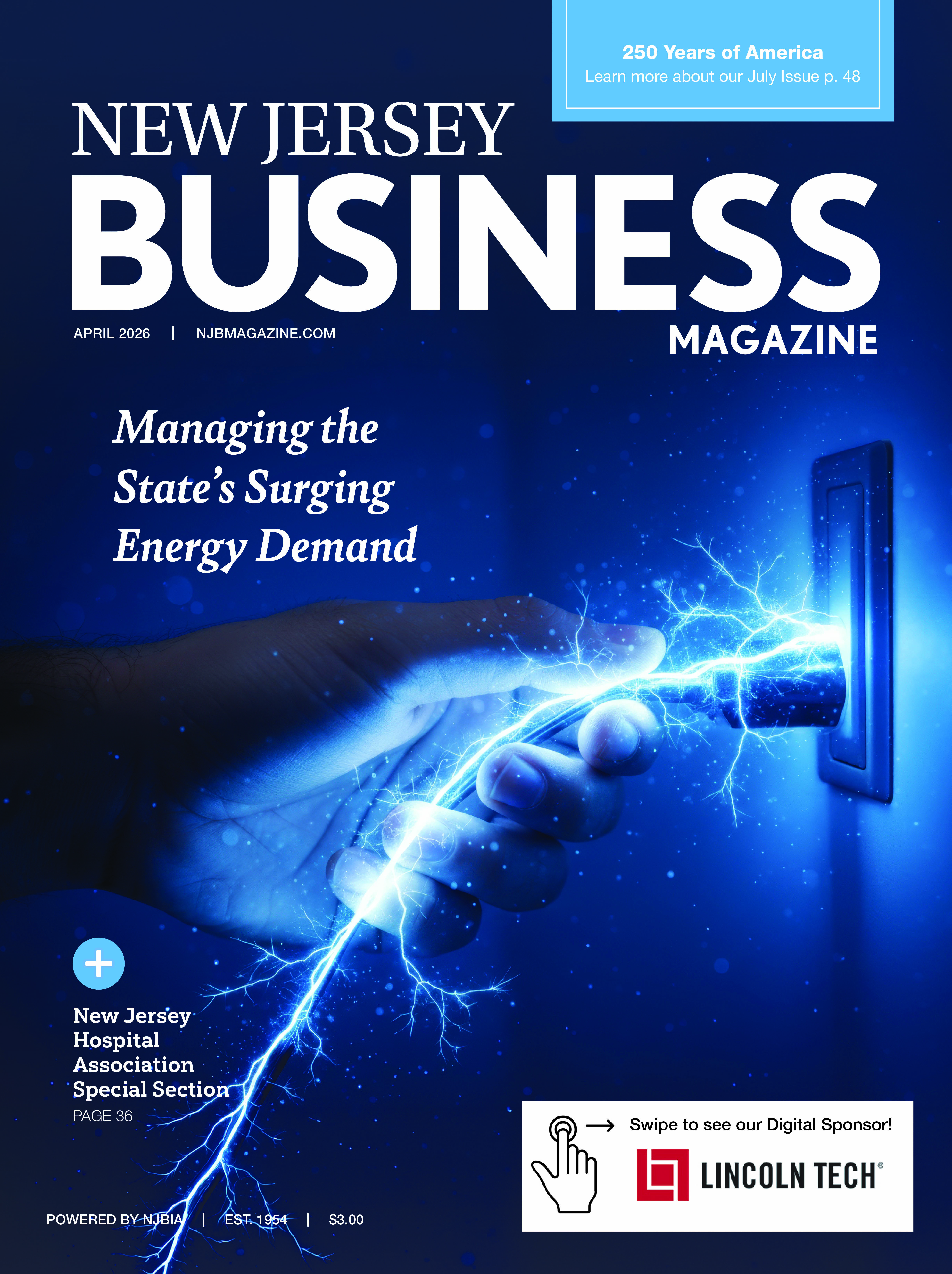

Coping With Rising Energy Costs
LEADERS AT THE STATE’S LARGEST POWER UTILITIES DISCUSS VARIOUS GAME PLANS IN HELPING BUSINESSES AND RESIDENTS LOWER THEIR ENERGY BILLS.
By Ron Marisco, Contributing Writer On Feb 5, 2026Skyrocketing energy costs are giving New Jersey’s businesses their own painful basic Economics 101 lessons due to exponentially increasing power needs with dramatically fewer in-state generation sources, industry experts say.
“It’s a supply and demand issue,’’ says Steven Cocchi, senior vice president, chief operating officer of South Jersey Industries (SJI), which delivers natural gas to some 700,000 customers via its subsidiaries South Jersey Gas and Elizabethtown Gas.
A confluence of factors has contributed to New Jersey’s energy woes over the past decade. Energy usage is ballooning, attributable to the voracious power appetites of expanding Artificial Intelligence (AI) applications, electric vehicle charging, electrification of building and transportation systems, and hotter summers driving up air-conditioning usage. Conversely, in-state energy generation has plummeted the past decade, as New Jersey has seen closures of the Oyster Creek nuclear plant and five coal-fired power plants, along with cancellation of massive offshore wind projects once touted by former Gov. Phil Murphy as a key long-term solution.
PJM Interconnection, the non-profit energy grid operator for the region, says these factors and an outdated grid system are responsible for the 20% rate increases customers saw in June, atop price jumps a year earlier.
“Demand has gone up tremendously in New Jersey … around the country, frankly,’’ says Cocchi. “It’s only going to continue to rise with policies around electrification, as well as AI data centers driving significant load demand increases. And where we sit in New Jersey, the generation that is needed to supply that electricity and serve that load is simply not there.”
Short-term prospects for curtailing rate hikes appear bleak while the state and industry figure out long-term solutions, creating a surge in small and large businesses seeking the help of utilities like PSE&G and Atlantic City Electric for monetary incentives and savings via energy efficiency programs.
“Costs aren’t going down anytime soon, despite what anyone says,” predicts Raymond Cantor, the New Jersey Business & Industry Association’s (NJBIA) deputy chief government affairs officer. “They’re only going to go up. … We have to figure out who pays and how we can lessen the pain.” Cantor adds: “Long term, we need to be serious about affordability, about reliability, and about making sure that we have enough generation to meet our economic growth needs.’’
Given that nuclear and natural gas already comprise nearly 90% of New Jersey’s power generation, Cantor and other industry representatives unsurprisingly say long-term solutions must include expansion of those sources to meet energy needs, rein in rate increases, and ensure system reliability. Modernizing the state’s energy grid, including upgrades to distribution systems and transmission lines, also is essential, these representatives say, while investments in battery storage facilities will help meet demand spikes in the short term.
Industry officials also tout the potential of Small Modular Reactors (SMRs); prefabricated and scalable nuclear plants that produce up to 300 MW, about one-third of the capacity of conventional nuclear reactors.
Richard Henning, president and CEO of the New Jersey Utilities Association, whose 13 members supply services to 1 million non-residential customers, comments, “As a state, we probably need to reform the energy master plan; maybe a little less emphasis on solar and wind, and a little more emphasis on nuclear capabilities … maybe renewable natural gas.”
Utility Costs a Major Issue in Gubernatorial Race
During her campaign, Gov. Mikie Sherrill pledged on Day 1 to “declare a state of emergency on utility costs and freeze utility rates,’’ focusing on more affordable and cleaner power generation. “This means immediately breaking ground on new solar and battery storage projects,’’ promises Sherrill, “expediting capacity upgrades at our existing nuclear plants, and streamlining the modernization of existing natural gas facilities to make them cleaner and more efficient – which will lower costs, reduce carbon emissions, and boost reliability and energy independence right now.’’
The Solutions
With the collapse of offshore wind projects, industry leaders consider solar the most promising renewable power source, but caution it is just a tiny slice of the generation pie. Meanwhile, grid limitations are delaying hookups for ready-to-go solar projects.
“Perhaps we could also be looking at natural gas as a steppingstone to cleaner technologies as we move along,’’ suggests NJUA’s Henning.
In the short term, PSE&G and Atlantic City Electric are encouraging business customers to take advantage of their free energy audits, incentives, and no interest loans for upgrades via an array of energy efficiency and sustainability programs. “The bottom line is we’re here to help,’’ says Rachael Fredericks, director of energy services for PSE&G. “Our customers now are seeing us more as a solutions provider.’’
For example, PSE&G’s “Direct Install’’ program for businesses has helped 18,500 companies complete 28,000 energy efficiency projects, resulting in $19 million in savings annually.
Atlantic City Electric also encourages business customers to take advantage of its affordability programs, which address equipment upgrades, building optimization, and education. “These programs help extend their budgets and allow them to accomplish more,’’ says Frank Nicosia, Atlantic City Electric’s senior manager of energy efficiency programs.
Since mid-2021, the utility’s business customers have received nearly $54 million in incentives, covering 1,674 projects, and saving more than 100 million kilowatt hours.
While SJI’s gas companies offer similar programs, longer-term fixes remain critically needed, says Cocchi of SJI. “The solution is more in-state generation, and that will take some time, both from a permitting and construction perspective, but also in supply chain constraints to getting the equipment for generation facilities ordered and delivered,’’ Cocchi says.
To access more business news, visit NJB News Now.
Related Articles:


- Accounting
- Artificial Intelligence
- Banking / Financial
- Coronavirus
- Diversity
- Economic Development
- Economy
- Energy
- Environment
- General Business
- Government
- Healthcare
- High-Tech
- Higher Ed
- Infrastructure
- Labor
- Law
- Life Sciences
- Manufacturing
- Meeting Places
- Mergers & Acquisitions
- New Hire/Promotion
- Philanthropy
- Real Estate
- Science & Technology
- Small Business
- Tourism
- Transportation
- Workforce Development
- Special Sections
- Sponsored Content
