

Progress on Clean Energy
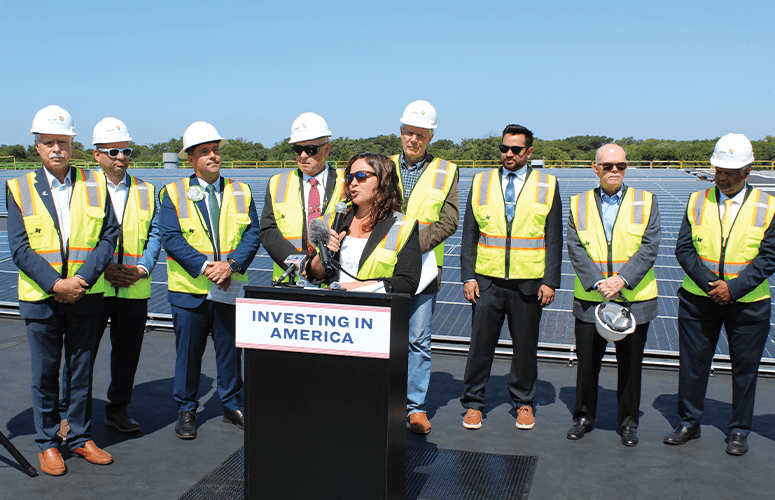
Power providers and the state continue their partnerships to reduce carbon emissions and deliver energy via renewable sources.
By Irene Maslowski, Contributing Writer On Dec 8, 2025The world’s shift to clean energy is part of an effort to reach “net zero” carbon emissions by mid-century – a goal where the amount of greenhouse gases we add to the atmosphere equals the amount we remove. Clean energy is generated from renewable or highly efficient sources that can be naturally replenished and minimize harm to the environment, producing little or no pollution or greenhouse gas emissions.
For New Jersey, this global goal translated into the Clean Energy Act of 2018 and the state’s Energy Master Plan. Originally targeting 100% clean electricity by 2050, Gov. Phil Murphy’s Executive Order 315 accelerated this goal to 2035, setting the stage for one of the most aggressive renewable energy transitions in the nation. The Clean Energy Act required that 21% of energy sold in the state come from Class I renewable sources – such as solar, wind, and geothermal energy – by 2020, escalating to 35% by 2025, and 50% by 2030.
The New Jersey Board of Public Utilities (NJBPU) administers New Jersey’s Clean Energy Program through its Division of Clean Energy, offering education, outreach, and financial incentives to residential customers, commercial businesses, industry, schools, and governmental entities, and works in partnership with the state’s utility companies.
“As public demand increases for electronic devices and cars, and the critical need for data centers and reliable data security-based operations grows, coupled with the devastation of storms and fires – it is imperative that we move forward with initiatives to meet the goal of clean energy on target,” says Christine Guhl-Sadovy, president of NJBPU.
The NJBPU doesn’t run a single energy efficiency project – it oversees a comprehensive, multi-billion-dollar portfolio of energy efficiency programs delivered through utilities statewide, targeting everything from residential homes to large commercial facilities, with proven results saving customers hundreds of millions of dollars annually while significantly reducing carbon emissions.
NJBPU recently approved the next generation of Energy Efficiency and Peak Demand Reduction programs, setting year-five targets for energy reduction at 1.57% for electric distribution companies and .55% for gas distribution companies, covering residences, commercial and industrial properties, and multifamily buildings, which puts the state on track to achieve the overall energy reduction goals of 2.0% for EDCs and .75% for GDCs.
These programs already have benefited 1.9 million customers from Public Service Electric & Gas (PSE&G), for example, with energy-saving offerings. Through participation in energy efficiency initiatives, customers are collectively saving nearly $640 million annually on their utility bills.
An example of a successful project is the Montclair Public Library, a building that had not undergone energy renovation since the 1990s. A $1.9 million energy efficiency upgrade included installation of high-efficiency boilers, a new chiller, digital controls, and smart thermostats, with nearly 40% of the total project cost – $749,096 – covered through PSE&G program incentives, securing over $125,000 in annual projected energy cost savings. The upgrades came at a critical time. During a heat wave the previous summer, outdated HVAC systems pushed indoor temperatures into the 90s, forcing the library to close parts of the building and move children’s programs outdoors. The project reduced the library’s energy consumption and environmental footprint, demonstrating how public institutions can model sustainability for the community.
The PSE&G energy renovation transformed the Montclair Public Library from a facility facing regular closures due to failing HVAC systems into a reliable, comfortable community hub – all while saving taxpayers more than $125,000 annually that can be reinvested in library services and programs for the community.
“Although federal priorities may shift, New Jersey has maintained a strong clean energy framework, and PSE&G continues to support the state’s goals through our suite of business and residential energy efficiency programs,” says Rachael Fredericks, director of energy services at PSE&G. “As energy costs rise, energy efficiency remains an effective tool that can help customers reduce their energy use and manage their utility costs. We recognize the important role we play in ensuring reliable, affordable, and cleaner energy for our customers, and we’ll continue working with the NJBPU and partners across the state to provide solutions that help customers manage their energy needs.”
Every business and every home is different, according to Fredericks. While some facilities may need a complete overhaul, others may only need optimization of their systems. With engineers and boots on the ground, PSE&G is able to assess the issue for both small and large businesses and, in some cases, make turnkey updates or major overhauls. Incentives and interest-free programs also support the affordability factors for customers. Energy efficiency is essential, but for many, cost savings is the driver.
“While holding back on replacing or optimizing older equipment may seem feasible, the money that could be saved could go back into the business or better serve the community,” notes Fredericks. “Cost savings for a hospital can benefit patients; for a college or university, it could be for students; and for non-profits, it could be a life-saving community center that supports families and children.”
The Boys and Girls Clubs of Paterson and Passaic (BGCPP) is a case in point. These clubs serve more than 1,400 youngsters each day across two 36,000-square-foot facilities, operating as a community hub for public activities and a second home for many children.
By leveraging PSE&G’s Direct Install Program, BGCPP upgraded seven inefficient HVAC units, the boiler, and the facility’s inadequate lighting. While the total project cost was $434,839, the program provided an 80% incentive covering $311,650, creating an estimated cost savings of $300,000, with the club saving an estimated $1,277 per month on energy bills.
Atlantic City Electric has also launched expanded programs. In January of this year, Atlantic City Electric added Building Carbon Reduction rebates for customers switching from fossil fuel-based equipment to electric, and an HVAC Workforce Development Program offering career opportunities and job training for residents across South Jersey.
Since July 2021, Atlantic City Electric’s programs have saved customers more than 140,000 megawatt hours of electricity, equivalent to nearly 17,000 households’ annual electricity consumption, and were projected to avoid more than 70,000 tons of CO2 emissions at the end of 2024.
“The NJBPU and all of New Jersey’s energy companies are working together to create a one-stop-shop platform, where customers can learn about rebates, find local contractors, and program offerings, and align utility efforts across the state,” concludes Guhl-Sadovy. “Together, we are dedicated to meeting the goal of clean energy as set forth by the state, for today and all future generations.”
To access more business news, visit NJB News Now.
Related Articles:

- Accounting
- Artificial Intelligence
- Banking / Financial
- Coronavirus
- Diversity
- Economic Development
- Economy
- Energy
- Environment
- General Business
- Government
- Healthcare
- High-Tech
- Higher Ed
- Infrastructure
- Labor
- Law
- Life Sciences
- Manufacturing
- Meeting Places
- Mergers & Acquisitions
- New Hire/Promotion
- Philanthropy
- Real Estate
- Science & Technology
- Small Business
- Tourism
- Transportation
- Workforce Development
- Special Sections
- Sponsored Content
