

What’s to Blame for NJ’s Rising Utility Costs?
By Jim Pytell, Managing Editor On Oct 29, 2025There has been plenty of finger-pointing about who is at fault for New Jersey’s rising utility costs. PJM Interconnection and the New Jersey Board of Public Utilities (NJBPU) are among the most criticized, while the Legislature and utility companies themselves have also drawn the ire of ratepayers, many of whom have seen their monthly electricity bills increase by 20% in recent months.
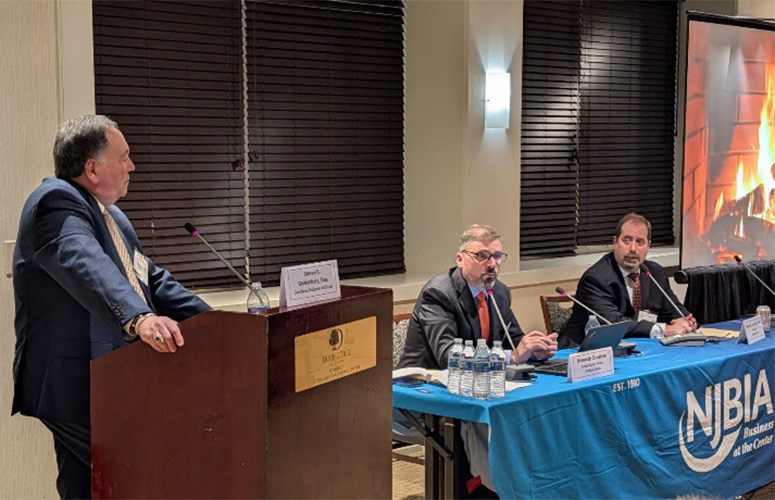
“Spoiler alert: Everyone is to blame,” said Steven S. Goldenberg, Esq., of Giordano, Halleran & Ciesla, who moderated a discussion on utility rates at NJBIA’s annual Energy and Environmental Policy Forum at the DoubleTree by Hilton Somerset Hotel and Conference Center.
“There is also no magic bullet to cure the issue,” Goldenberg added.
Critics of PJM, the interstate power grid that New Jersey is a part of, have pointed to the results of its 2026/2027 Base Residual Auction (BRA), which secures the projected electricity needs for those in its region of operation.
The auction closed at record highs for a second year in a row, hitting a price cap of $325/MW-day. This 22% increase in capacity prices follows last year’s BRA that saw an 800% jump. As a result, many New Jersey ratepayers have seen a 20% cost increase in their electric bills.
“To the energy market, that high-capacity price is a signal that we need more capacity, and you should start building because we need to meet increased demand,” Goldenberg said.
Perhaps the biggest culprit of this increase in demand are data centers, which consume significant amounts of power. To make matters worse, projections show this consumption will rise substantially in the coming years.
“If you look at demand on the PJM system over a period of years, it remained relatively flat. There were no big bumps. But with the introduction of data centers, you’re making projections of exponential growth, and that’s what’s freaking out the market right now,” Goldenberg said.
New Jersey’s electrification goals have also contributed to the problem.
“It’s the policy of the state right now to try to move away from fossil fuels and electrify. Now, that’s fine, and it’s an admirable goal, but you [must] realize that when you do that, you increase demand,” Goldenberg said.
Further compounding the issue is that at the same time demand is increasing, there have been significant reductions in energy supply via the retirements of coal and gas-fired generation in the state, which has yet to be replaced by renewable energy sources.
“We did see a lot of the generation close over the last 10 years, because it was getting a market signal that it wasn’t needed,” said Brian Lipman, director, NJBPU Division of Rate Counsel. “The reality is, up until two to three years ago, before we started seeing AI, load was either stable or going down even with electrification and everything else, because we were getting more efficient. We could have handled that load growth of electrification. [The problem] is 100% the data centers.”
Lipman added that there is also real concern with hooking up a data center that doesn’t have a corresponding generation that can meet demand. “Right now, we are on the path to rolling blackouts, and that is something that is unacceptable,” he said.
At the same time, he said that while one could argue how much of an energy importer New Jersey should be, or whether it’s economically [feasible] to build in the state at this time, the reality is, “when it’s economically [advantageous] to build outside the state and bring electricity in, that’s what we should be doing. We should be doing what is cheapest for New Jersey.”
Finally, he pointed to the issue of PJM trying to figure out the best way to manage more electric demand than it has supply.
“That is going to be a problem for a while because a new power plant is not easy to build,” Lipman said. “It takes roughly five years to build a gas power plant and nine to 10 years to get a nuclear power plant online. There is no short-term, immediate solution.”
Kenneth Sheehan, partner, Greenbaum, Rowe, Smith & Davis, explained that one of the primary roles of the rate councel and the NJBPU is to balance the need to build, the need to move forward, the need to generate, the need to distribute, and the need for transmission, with the need for developers to have a financial incentive to deal with. But he cautions that the financial incentive can’t be such that the rate payers can’t pay for it.
“New Jersey does not have enough generation,” Sheehan said. “If we’re not going to take over and have the State of New Jersey own and build its own generation, then other people have to build it. For other people to build it, they need to pay money.”
To access more business news, visit NJB News Now.
Related Articles:

- Accounting
- Artificial Intelligence
- Banking / Financial
- Coronavirus
- Diversity
- Economic Development
- Economy
- Energy
- Environment
- General Business
- Government
- Healthcare
- High-Tech
- Higher Ed
- Infrastructure
- Labor
- Law
- Life Sciences
- Manufacturing
- Meeting Places
- Mergers & Acquisitions
- New Hire/Promotion
- Philanthropy
- Real Estate
- Science & Technology
- Small Business
- Tourism
- Transportation
- Workforce Development
- Special Sections
- Sponsored Content
