

Opinions and Views Vary at NJBIA’s Budget Watch Party
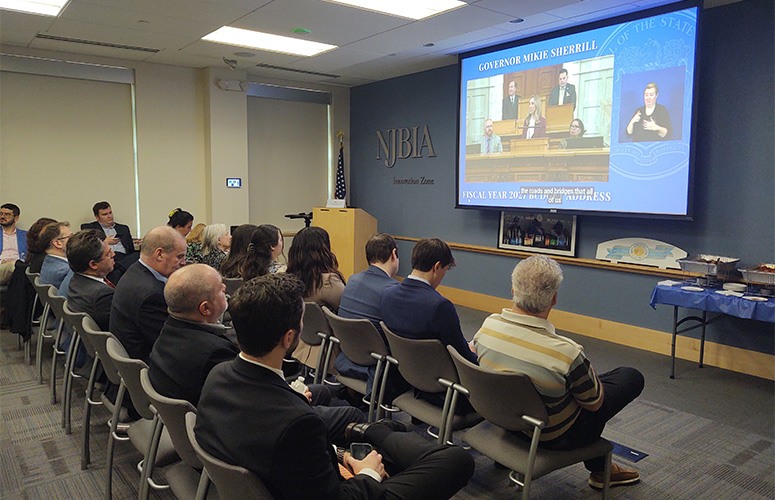
By Anthony Birritteri, Editor-in-Chief On Mar 11, 2026Business leaders and state legislators gathered at New Jersey Business & Industry Association (NJBIA) headquarters in Trenton yesterday to see Gov. Mikie Sherrill deliver her $60.7 billion FY 2027 budget proposal. Audience reviews at the budget watch party were fairly positive, as most attendees understood that hard choices had to be made as the state was facing a $3 billion structural budget deficit, which the governor balanced with nearly $2 billion in spending cuts, $700 million in “revenue solutions” that impact businesses, and using state surplus money (reducing the surplus from $6.7 billion at the end of FY2026 to the $5.4 billion projected at the end of FY2027).
At the same time, the proposal calls for $7.3 billion in spending to fully fund the state’s employee pension system, $4.2 billion for property tax relief while lowering the qualifying threshold for the Stay NJ program, $12.4 billion for K-12 education aid, and more than $1 billion for NJ TRANSIT.
According to Christopher Emigholz, chief government affairs officer at NJBIA, Sherrill’s budget proposal is a step in the right direction because all the “pain” does not fall on businesses, as had been seen in Gov. Phil Murphy’s past budgets.
Perhaps the biggest impact on citizens, specifically seniors, is reducing the Stay NJ property tax relief programs threshold from $500,000 to $250,000 and capping the total refund amount to $4,000.
Emigholz is disappointed that the business community is seeing three tax change proposals that will impact them. One is a proposal for a temporary cap of up to $1 million per year for the next three years on the New Jersey Economic Development Authority’s Net Operating Loss program. This would generate some $485 million for the state per year.
There is also a change to the Alternative Business Calculation. Introduced 15 years ago to help small businesses during the Great Recession, Sherril said larger companies have been taking advantage of it. She proposes capping eligibility to businesses with gross revenues of $1 million per year.
“While it may be well intentioned to better focus this tax program on smaller businesses, NJBIA is worried that the proposed threshold is too low because it excludes businesses with $1 million in gross revenue and could discourage entrepreneurial investment,” Emigholz said.
Another issue is a proposed employer healthcare assistance contribution that, according to the state treasurer’s office, would incentivize businesses – that don’t provide healthcare to their employees – to provide coverage. Specifically, employers with 50 or more workers enrolled in the state’s Family Care program would be subject to a charge to offset the cost of providing Medicaid in the state.
Emigholz says the assessment on a company with 1,000 employees receiving Medicaid, for example, would be $725 per employee who is receiving coverage. “That business, perhaps a large retail chain for example, will be asked to give back $725,000 to the state to cover employees getting government healthcare?” questions Emigholz. “It’s misguided policy because certain part-time employees choose to receive Medicaid. They may have declined healthcare insurance provided by the employer because maybe the co-pay or deductible was higher than Medicaid. So, an employer will now get fined for offering healthcare that is not accepted? It’s a misaligned policy.”
Cassandra Cummings, CEO of Thomas Instrumentation Inc., Cape May Court House, does not like that the Alternative Business Calculation is being capped at $1 million. “That excludes us, even though we are a small business. We need to hire people, but we can’t with all this overhead, such as healthcare and energy costs, plus taxes,” she said.
In the budget address, there was no talk of lowering the state’s Corporate Business Tax (CBT), which is the highest in the nation with the Corporate Transit Fee included (to support NJ TRANSIT). “I’m down in Cape May County, we don’t have a NJ TRANSIT system, yet we are paying a tax for that? That’s not fair,” Cummings said.
She also commented that with Pennsylvania’s efforts to lower its CBT over the next few years, her competition as an electronics manufacturer is not just China, but her neighboring state. “We’ve been around since 1971. We are not going anywhere and will ride this out, but I would have liked to be able to expand and grow. … [the state] is tying the hands of the small business sector and not letting us blossom,” Cummings said.
Peter Connolly, president of the New Jersey Manufacturing Extension Program (NJMEP), said Sherrill spoke honestly and directly in addressing the state’s fiscal issues. “I think that Republicans are cautiously optimistic that both parties and the governor can work together. That is what I am hearing from both sides of the aisle; that the governor is addressing the tough issues,” Connolly said.
As for NJMEP, Connolly hopes that the organization, which received a $1 million cut in last year’s budget, will see full funding for the program at $2 million for FY2027. The organization is also receiving $3.3 million per year as a drawdown from the federal government over the next five years.
Dr. Teik Lim, president of the New Jersey Institute of Technology, said he admired the governor for being articulate and clear with her message. “Whether you are on the winning or losing side, she provided clarity,” Lim said.
“I think her support for K-12 education is great. I’m hoping higher education will fare well, too. Higher education is the key to economic progress, to workforce development, to social and economic mobility,” Lim said.
Chrissy Buteas, president and CEO of the HealthCare Institute of New Jersey (HINJ), said she is excited to work with the governor on pharmacy benefit manager (PBM) reform, which will deliver drug savings. “Common-sense PBM reform is one of the most effective and immediate ways to lower healthcare costs, and we commend the governor for her continued focus on patients and affordability,” said Buteas. “Less than half of the money spent on prescription medicines goes to the company that makes the medicine – the rest goes to middlemen within the supply chain, like insurers and PBMs. Whether enforcing current or enacting new legislation and regulations, bringing more transparency, and reducing profiteering incentives within the PBM structures will bring real and immediate relief to patients. We will work with the governor and the Legislature to enact these proposals as quickly as possible.”
Meanwhile, former State Senator Steve Oroho (R-24) who was a longtime member of the Senate Budget Committee and is now with Porzio Governmental Affairs, was dismayed that the budget proposal was approximately $1 billion more than Gov. Murphy’s last budget. He also said that there are things the state can do right away to save money and boost the economy, such as implementing the Red Tape Review Commission, which had overwhelming support as a bill in the Legislature, but was vetoed by Gov. Murphy.
Oroho also said New Jersey should follow Pennsylvania in not taxing retirement income, while saying that reducing the Stay NJ eligibility threshold from $500,000 to $250,000 may cause seniors to leave the state, going against Assembly Speaker Craig Coughlin’s original intent for the program.
Overall, NJBIA President & CEO Michele Siekerka said that that governor proposed an attentive budget through a transparent process, as promised. “There is intent with this budget to find efficiencies and the start of necessary, and yes, difficult, spending reductions to right our fiscal ship after years of unsustainable budgets by the previous administration,” Siekerka said. “We appreciate that the budgetary challenges facing New Jersey are not exclusively being thrust upon our already beleaguered business community, which was too often the case in recent years. Rather, there is a better balance between spending cuts and the business tax changes being proposed.”
To access more business news, visit NJB News Now.
Related Articles:


- Accounting
- Artificial Intelligence
- Banking / Financial
- Coronavirus
- Diversity
- Economic Development
- Economy
- Energy
- Environment
- General Business
- Government
- Healthcare
- High-Tech
- Higher Ed
- Infrastructure
- Labor
- Law
- Life Sciences
- Manufacturing
- Meeting Places
- Mergers & Acquisitions
- New Hire/Promotion
- Philanthropy
- Real Estate
- Science & Technology
- Small Business
- Tourism
- Transportation
- Workforce Development
- Special Sections
- Sponsored Content
