


Sherrill’s Key Advisors Tout Commitment to Efficiency and Transparency to Business Community
By Jim Pytell, Managing Editor On Mar 12, 2026It’s been a month and a half since Gov. Mikie Sherrill was sworn in as New Jersey’s 57th governor, and so far, her administration has shown intent and engagement with the state’s job creators, particularly when it comes to issues of efficiency and transparency.
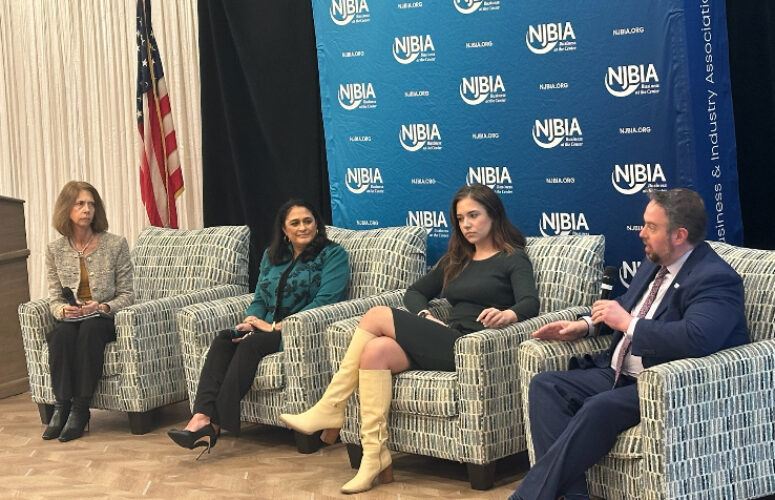
“We want to get out across the state to hear about the challenges that businesses are facing as we are simultaneously laying the foundation to really do the work that is necessary,” Kellie Doucette, New Jersey’s first Chief Operating Officer (COO) said this morning at NJBIA’s Meet the Decision Makers event in Edison.
Doucette was appointed as the state’s first COO in December, a position that was created under Sherrill’s Executive Order No. 4, which established the Office of the Chief Operating Officer. The governor cited this and the appointment of Doucette as a first step toward addressing the state’s efficiency and transparency issues.
“On Day One, the governor signed executive orders to begin reducing costs and delays for businesses and bring greater accountability and transparency to permitting and regulatory processes,” Doucette said. “These actions really launched a cross-agency effort to streamline approvals, eliminate redundancies, and establish clearer and more predictable timelines.”
She said that the administration has already begun to engage in agency-level permitting reviews with the Departments of Transportation, Community Affairs and Environmental Protection, for example.
“We have also directed all state agencies to complete a comprehensive catalogue of permits and approvals that are due before the end of April. Each agency is required to detail and quantify their permitting processes and provide recommendations for simplification,” she said, adding that her team has been holding regular office hours with agencies to answer questions.
“It is really important to us that all this work be collaborative with all of you and the residents and businesses of New Jersey, but also with the state workforce that has been doing this for so long,” Doucette said.
She also cited the development of a real-time permitting dashboard that will allow applicants to track progress, increase transparency, and help identify bottlenecks.
“As you all know, too many businesses currently have no clear visibility into where their applications stand or who’s responsible for the next step. The dashboard makes that process visible to applicants and agencies alike, and will build accountability into the system. …[Overall] we are just taking a microscope and examining the permit processes in depth, identifying where interagency coordination breaks down, and trying to develop concrete opportunities to reduce delays.”
Beyond permitting, Doucette also said the administration is focused on making New Jersey’s broader regulatory environment more workable.
She pointed to Executive Order No. 7, which freezes new regulatory actions for 90 days.
“During this period, our office is reviewing every proposed rule in the pipeline,” Doucette said. “Agencies were required to notify the governor’s office by Feb. 2 of any proposals whose non-adoption would adversely affect public health or security, and everything else is subject to review – and we are working on that systematically.”
Finally, Doucette said that the office is also working with agencies to assess their existing regulatory frameworks, adding that her office is focused on the operational side of how agencies interact with the businesses they regulate.
“It’s really all about execution and turning priorities into measurable results for residents, businesses, and public servants who deliver these services every day,” Doucette continued. “And while some of these are going to be really big challenges, it’s really amazing to me how much of this work really comes down to listening and having an open mind about thinking how things can be different.”
Evidently, this commitment to transparency extends beyond state agencies’ interactions with businesses.
Sherrill’s chief of staff, Alex Ball, told the crowd, “I think we’ve been really clear about the governor’s agenda – lowering costs, protecting kids, and delivering on accountability and making government more transparent for New Jerseyans. We want to make sure that we have a structure that is going to deliver on these things.”
She said that leading up to the budget address, every single member of the Legislature – Democrat and Republican – had heard from her office multiple times.
“Many of them had met with the governor herself or had met with our team,” Ball said. “We really tried to make sure that we are understanding the needs of their constituents and also learning from their expertise in Trenton. … What you heard in the budget is what the governor’s mission was from the start of this administration. That was to make sure that we were reining in spending in Trenton, being more fiscally responsible, setting ourselves up to get at the structural deficit, and creating a process that is more transparent to all of you and more transparent to people across New Jersey.”
To access more business news, visit NJB News Now.
Related Articles:


- Accounting
- Artificial Intelligence
- Banking / Financial
- Coronavirus
- Diversity
- Economic Development
- Economy
- Energy
- Environment
- General Business
- Government
- Healthcare
- High-Tech
- Higher Ed
- Infrastructure
- Labor
- Law
- Life Sciences
- Manufacturing
- Meeting Places
- Mergers & Acquisitions
- New Hire/Promotion
- Philanthropy
- Real Estate
- Science & Technology
- Small Business
- Tourism
- Transportation
- Workforce Development
- Special Sections
- Sponsored Content
