
Businesses Don’t Come Away Unscathed from Sherrill’s First Spending Proposal
By Jim Pytell, Managing Editor On Mar 11, 2026Gov. Mikie Sherrill delivered her first state spending plan as governor yesterday, which included a record $60.7 billion in spending for FY 2027 – a roughly 3% increase over the previous fiscal year’s $58.8 billion budget.
New Jersey Republicans described it as more of the same.
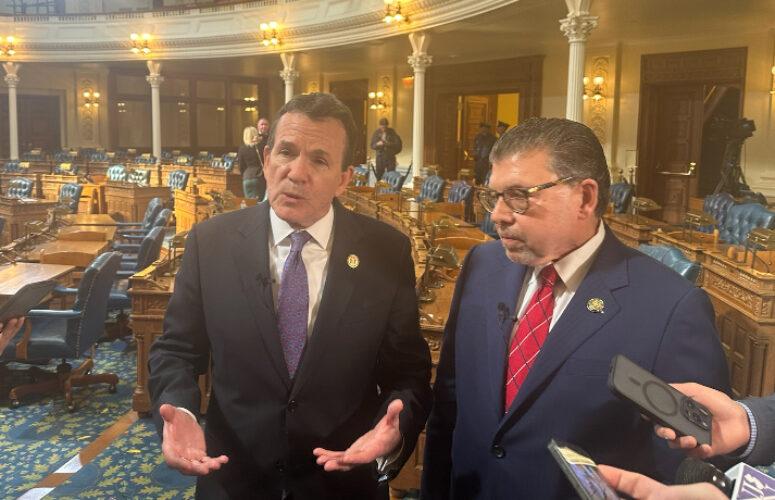
“New governor, same old song,” Assembly Republican Budget Officer Brian Rumpf said. “We have numerous revenue enhancements, or whatever the new terminology may be. For Republicans, we call it taxes, because we call it like it is. When we’re talking about the new spending in this budget, what we’re talking about is new taxes. And there’s close to $1 billion worth in this budget.”
“Spending continues to move in the wrong direction – up and up, just like the last eight years. This is more of the same, and nothing, apparently, has changed,” added Assembly Republican Conference Leader Christopher P. DePhillips. “Overall, this budget is not a win for the people of this state and does not improve affordability in New Jersey.”
While the budget does not call for new taxes on individual New Jerseyans, it does call for the phasing out of certain business deductions and increasing employer healthcare contributions – things that the GOP warns will ultimately be felt by consumers.
“The business deductions that are being eliminated – that’s in essence a tax,” Senate Republican Leader Anthony M. Bucco said. “That revenue that is going to be raised is going to be borne – not only by the businesses – but by the consumers that those businesses sell to. Businesses don’t just eat those expenses, they pass it on in their products and services.”
“Businesses pass all these taxes down onto everybody who buy their products and their services, so this is not an affordability budget yet,” added Senate Republican Budget Officer Declan O’Scanlon.
The three major areas of concern for businesses include:
- A temporary capping of Net Operating Loss deductions at $1 million for three years.
- Limiting the Alternative Business Calculation (ABC) deduction to small businesses.
- A proposed per-employee fee on businesses with more than 50 employees using Medicaid.
On the ABC deduction, NJBIA Chief Government Affairs Officer Christopher Emigholz said that while it may be well intentioned to better focus the tax program on smaller businesses, the worry is that the proposed threshold is too low because it excludes businesses with $1 million in gross revenue and could discourage entrepreneurial investment.
Then, there’s the Employer Healthcare Assistance Contribution aimed at incentivizing businesses that do not provide employee health benefits to offer health insurance coverage. Employers with 50 or more employees enrolled in NJ FamilyCare would be charged a fee to defray a portion of the costs of the program.
“This is perhaps the most troubling part of the budget proposal for the business community,” said Emigholz. “This establishes a situation where employers can be penalized even if they offer health coverage for their workers, which is already one of the largest expenses they absorb every year.”
“We do appreciate that the budgetary challenges facing New Jersey are not exclusively being thrust upon our already beleaguered business community, which was too often the case in recent years,” said NJBIA President and CEO Michele Siekerka. “Rather, there is a better balance between spending cuts and the business tax changes being proposed.
“We encourage the Sherrill administration and the Legislature to unequivocally apply discipline to avoid clandestine, add-on spending for local expenditures. These last-minute legislative earmarks violate the goals of transparency and have put New Jersey in a deeper hole than necessary,” she added.
“We are willing to work together and are happy to go down the path of coming together on all of these things,” Bucco said. “One thing that I think we really need to pay attention to is transparency. If this process rolls out in an open and transparent manner, and we actually get a budget ahead of time that we are able to debate and talk about, that will be a major change from what we have had in the past.”
“I am very happy to hear that the governor is, at least rhetorically saying, that those days are over. We’ll see,” O’Scanlon said.
To access more business news, visit NJB News Now.
Related Articles: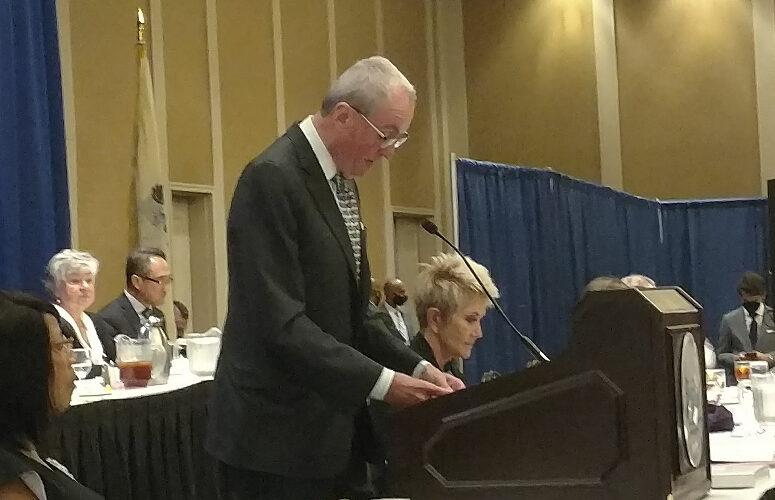


- Accounting
- Artificial Intelligence
- Banking / Financial
- Coronavirus
- Diversity
- Economic Development
- Economy
- Energy
- Environment
- General Business
- Government
- Healthcare
- High-Tech
- Higher Ed
- Infrastructure
- Labor
- Law
- Life Sciences
- Manufacturing
- Meeting Places
- Mergers & Acquisitions
- New Hire/Promotion
- Philanthropy
- Real Estate
- Science & Technology
- Small Business
- Tourism
- Transportation
- Workforce Development
- Special Sections
- Sponsored Content
