

Holy Name Launches New Neuroendovascular Institute
On Feb 11, 2026Holy Name has launched the state-of-the-art Douglas M. Noble, M.D. Neuroendovascular Institute, marking a major milestone that positions the hospital as one of the region’s leading centers for stroke treatment, neurovascular care, and complex neurosurgical interventions.
The Neuroendovascular Institute will combine Holy Name’s neurologists and interventional specialists with the nationally-renowned experts from Columbia University Irving Medical Center.
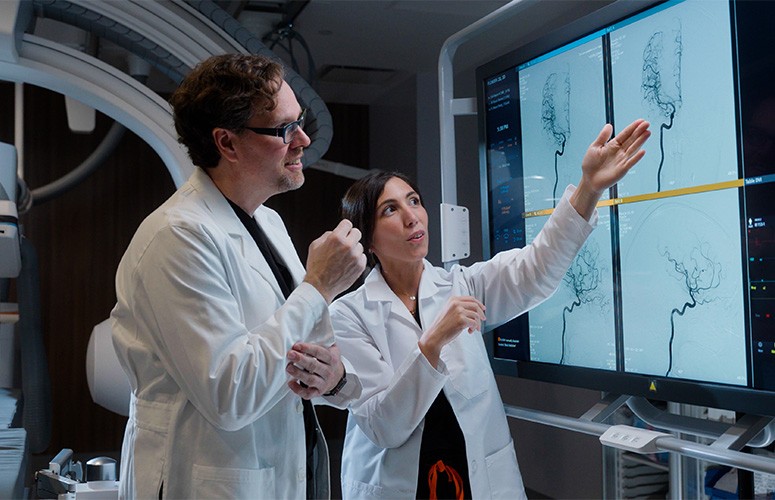
The Institute will utilize the Siemens Artis icono biplane, a system for diagnosing and treating complex neuroendovascular conditions. The biplane angiography system provides simultaneous, dual-angle imaging for a near-3D view of the brain and spine, giving neurosurgeons millimeter-level precision. It reduces radiation exposure, cuts contrast use, and enhances both the precision and safety of procedures, allowing physicians to treat patients with minimally invasive techniques. Holy Name is one of only two hospitals in the region to offer this technology.
“Cerebrovascular and endovascular care is inherently complex, but our highly trained team and cutting-edge technologies enable us to deliver exceptional, precise treatment,” said Eleonora Spinazzi, MD, Cerebrovascular and Endovascular Neurosurgeon at Columbia University Irving Medical Center, and Director of Holy Name’s Neuroendovascular Institute.
With the new biplane, Holy Name can now provide the full spectrum of neurovascular and spine interventions, including:
- Emergency stroke thrombectomy
- Intracranial and extracranial aneurysm treatment
- Embolization of abnormal blood vessel connections such as arteriovenous malformations and dural arteriovenous fistulas
- Carotid and intracranial stenting
- Tumor embolization
- Middle meningeal artery embolization for chronic subdural hematomas
- Spinal tumor and fistula embolization
- Management of complex intracranial hemorrhage
- Diagnostic cerebral and spinal angiography
“This investment marks a turning point for Holy Name,” said Mike Maron, CEO and president. “We are not just expanding services, we are redefining what neurological care looks like for our community and the entire region.”
Having advanced imaging technologies, such as a biplane system, is a requirement for hospitals seeking certification as a Comprehensive Stroke Center, the highest national standard for stroke care. These centers have the expertise to treat all types of stroke, including both blood clot-related (ischemic) and bleeding (hemorrhagic) strokes, and function as a resource for local hospitals that treat high-acuity neurological emergencies.
“We are proud of this partnership, as it builds on our award-winning neurosciences program and helps ensure patients have access to the most advanced treatments close to home,” said Vasantha K. Kondamudi, MD, Chief Medical Officer at Holy Name. “With Dr. Spinazzi’s expertise and the support of Columbia’s renowned medical center, Holy Name is well-positioned to care for patients facing the most challenging neurological conditions.”
The launch of the Institute further strengthens Holy Name’s partnership with Columbia University Irving Medical Center’s Department of Neurosurgery.
The institute’s director, Dr. Spinazzi, brings academic-level subspecialty expertise directly to the Holy Name community. E. Sander Connolly, MD, Chair of Neurosurgery at Columbia and the newly appointed Chief of Neurosurgery at Holy Name, provides strategic oversight to ensure that the institute’s direction aligns with patient needs.
Dr. Spinazzi is supported by an expanded Columbia neurosurgical team, including endovascular specialists Sean Lavine, MD; Dean Chou, MD; Alexander Ramos, MD; and Grace Mandigo, MD, who perform procedures and help develop a fully integrated, premier center of excellence.
Holy Name is also rolling out a next-generation, real-time EMS-integrated stroke activation system through the Helix platform. This system notifies the entire stroke team, including EMS, emergency department, neurology, neurosurgery, and imaging, as soon as paramedics identify a potential stroke in the field. The result is a faster, more coordinated response, shorter “door-to-recanalization” times, and improved patient outcomes.
To access more business news, visit NJB News Now.
Related Articles:


- Accounting
- Artificial Intelligence
- Banking / Financial
- Coronavirus
- Diversity
- Economic Development
- Economy
- Energy
- Environment
- General Business
- Government
- Healthcare
- High-Tech
- Higher Ed
- Infrastructure
- Labor
- Law
- Life Sciences
- Manufacturing
- Meeting Places
- Mergers & Acquisitions
- New Hire/Promotion
- Philanthropy
- Real Estate
- Science & Technology
- Small Business
- Tourism
- Transportation
- Workforce Development
- Special Sections
- Sponsored Content
