

MacWeb Opens US East Region Cloud Service Data Center in Secaucus
On Nov 20, 2025MacWeb, a Santa Clara, California-based provider of Mac-based cloud infrastructure for AI inference and iOS application workloads, has launched its US East region cloud service in the New York metropolitan area. Based in Secaucus, the new Class A data center’s presence plants MacWeb’s flag in the US East region, complementing its existing US West (Silicon Valley) data center, and giving customers volume deployment of cloud Mac mini and Mac Studio cluster nodes in a facility just minutes from Manhattan and major network exchanges.
The US East deployment is designed for teams that need Mac production workloads in the cloud and at scale—typically 50 to 500 Mac mini or Mac Studio cluster nodes per customer—including CI/CD farms for iOS and macOS, media and creative pipelines, and AI inference on Apple silicon. Located in Secaucus, New Jersey, MacWeb’s clusters sit on a high-performance backbone with low-latency connectivity to New York City and onward to London, Boston, Montreal, Chicago, and Washington, D.C. This makes the region well-suited to hybrid architectures that span multiple clouds and to companies looking to diversify their cloud service providers.
“Many application and AI engineers already develop on the Mac and want their cloud infrastructure to look and feel like what’s on their desk,” said Eric Bickford, CEO of MacWeb. “MacWeb gives them that environment in the cloud using clustered bare-metal Apple silicon hardware in a region that sits close to the hyperscalers they already use. The US East region is for teams that care about latency, cost, and getting into production quickly, not just experimenting.”
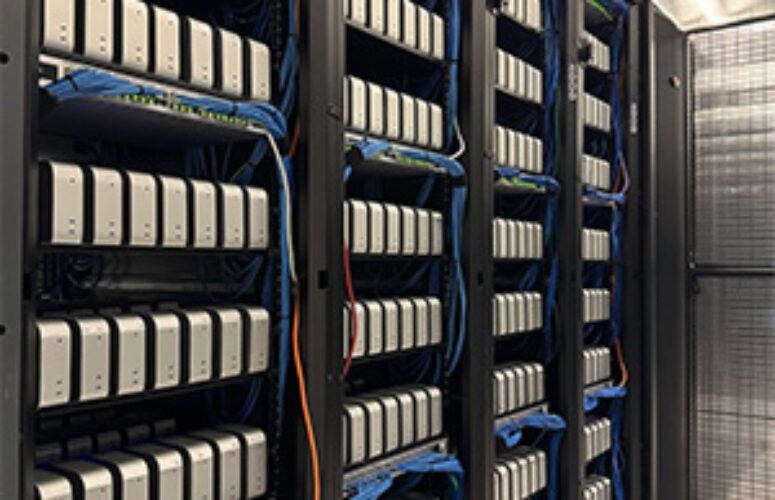
MacWeb’s architecture is based on clustered, bare-metal Mac hardware—currently Mac mini and Mac Studio—operating as dedicated nodes for each customer. These Apple silicon machines offer high performance, robust security features, and large unified memory configurations at commodity hardware prices, which Bickford sees as a strong fit for AI inference and application runtimes rather than large-scale model training.
“Traditional data centers are dominated by 1U and 2U servers that push hard on power and cooling,” Bickford added. “A dense Mac mini cluster gives our customers the compute they need in a compact footprint with high performance per watt. For operators who are already thinking about grid constraints and capacity planning, that matters as much as raw speed.”
Key capabilities of MacWeb’s US East and US West Regions include:
- Volume deployments of 50 to 500+ cloud Mac mini and Mac Studio nodes per customer, designed for production workloads rather than one-off servers.
- 10G network ports for Ultimate M4 Pro cloud Mac mini and all cloud Mac Studio nodes.
- Cold aisle containment and locked cages with open racks to improve airflow and cooling for dense Mac clusters.
- 24/7 security and support, aligned with enterprise expectations.
- Lower latency from cloud application servers and virtual remote desktops to edge devices and customers across the eastern region of the United States, Canada, and the Caribbean.
- Proximity to US East hyperscalers and big-tech cloud providers, supporting hybrid deployments and cloud diversification strategies.
The company is targeting several overlapping customer segments in the New York metro area: AI and application developers, iOS and macOS engineering teams, and creative professionals in media, advertising, and design who already rely on Mac workflows. MacWeb’s growth has been driven by startups that need to get workloads running quickly and cheaply and are less concerned with the brand signaling that comes from choosing a large hyperscale cloud provider.
“Two things are driving our growth right now: fast cycle time to deployment and being a fraction of the cost of running equivalent Mac workloads elsewhere,” Bickford said. “AWS is great for short-term, peak demand. Our customers tend to run steady workloads and want a long-term relationship. We can usually have a cluster online in days, not months—and in a world where some teams are waiting a year for access to Nvidia GPUs, that’s a real difference.”
The New York–metro Class A data center that underpins MacWeb’s new operations provides the underlying power, cooling, and security envelope for the company’s East Region services. It features 10 MW of total capacity, 4 x 1.4 MW UPS systems in N+1 configuration, advanced chilled-water cooling, biometric access controls, 24x7x365 on-site engineers, and adherence to PCI-DSS, HIPAA, HECVAT, SOC 2 Type II, and SOC 3 standards.
“MacWeb’s deployment in our New York–metro facility illustrates how modern data centers are evolving with customer needs around AI and application workloads,” said Marty Hasting, regional director at Evocative. “Pairing high-density, low-power Mac clusters with our redundant, compliant infrastructure gives enterprises and startups in the New York metro area another option as they think through hybrid cloud architectures, developer productivity, and cloud diversification.”
To access more business news, visit NJB News Now.
Related Articles:


- Accounting
- Artificial Intelligence
- Banking / Financial
- Coronavirus
- Diversity
- Economic Development
- Economy
- Energy
- Environment
- General Business
- Government
- Healthcare
- High-Tech
- Higher Ed
- Infrastructure
- Labor
- Law
- Life Sciences
- Manufacturing
- Meeting Places
- Mergers & Acquisitions
- New Hire/Promotion
- Philanthropy
- Real Estate
- Science & Technology
- Small Business
- Tourism
- Transportation
- Workforce Development
- Special Sections
- Sponsored Content
